




Revision of Installing, Updating and Removing Software from Mon, 01/10/2011 - 02:44
The revisions let you track differences between multiple versions of a post.
Software on GNU/Linux systems is typically installed by one of several methods.
- Using the more advanced Synaptic Package Manager.
- Typing sudo apt-get [command] [package name] commands into a non-graphical console (located in the Main Menu at Accessories → Terminal). Type apt-get -h for a full list of commands. The most important commands include:
- sudo apt-get install [package name] to fetch and install a package
- sudo apt-get remove [package name] to uninstall a package
- sudo apt-get upgrade to update packages. This is the same as using the graphical Update Manager.
- sudo apt-get autoremove to remove unnecessary leftover packages
- Adding a Launchpad PPA to your Software Sources (located in the Main Menu at System → Administration → Software Sources).
- Building from a source archive (generally in .tar.gz format). This is the most advanced method. You will likely never need to install software this way, and because you could mess up your installation if you do something wrong, it's suggested you avoid this method if you are new.
Note: This manual does not aim to provide comprehensive documentation for any of the software applications mentioned. Rather, it is a beginner's introduction to their most basic features. Detailed user manuals for each programs are available elsewhere.
If you're new to GNU/Linux, you may be unfamiliar with the way software is installed. It is usually done by one of the following methods.
The application we will download in the examples in this manual is Audacity, a popular sound editing and recording program.
Installing From the Repository
The simple way
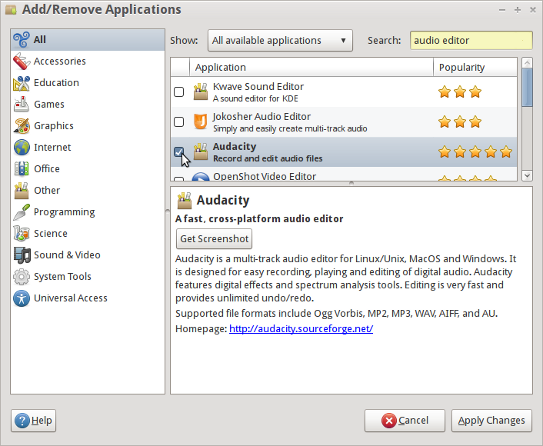
First, open the Add/Remove Applications tool from the Main Menu.
In this simple program, you can browse thousands of applications to add and remove. Only a minority of the applications from the Trisquel repos are shown, generally the more popular and graphical ones.
Using Synaptic Package Manager
Using the command line
Adding Packages to the Repos
Installing From Archives
.deb archives
.deb archives are used by dpkg, the package management system of Debian and its many derivatives (including Trisquel), to handle software installation.
To install from a .deb, first download it. Audacity .deb's for Ubuntu Lucid/Trisquel Taranis can be downloaded from any of the mirrors here. Click the file to open it. A graphical application called GDebi runs and the package is ready to be installed.

In the above example, Audacity requires 5 other packages to work. Such packages are called "dependencies". These files are fetched from the repos during installation.
Converting .rpm to .deb
Perhaps the package you want is available in .rpm format but not .deb. RPM is an alternate package management system that many distributions (not including Triquel) use by default. To convert .rpm archives to .deb, there is a tool called alien which is already installed in Trisquel.
Download the .rpm package you want to convert. Audacity .rpm's can be downloaded here. The version we are using in this example is 1.3.12-0.6.beta.fc13.i686.
Open a terminal.
Use ''cd [directory] to go to the directory the .rpm was downloaded to. For example, if it is in your Downloads folder, run the following command:
cd /home/[username]/DownloadsAfterwards, run:
sudo alien -k audacity-1.3.12-0.6.beta.fc13.i686.rpmA .deb will be created in the same directory. Now you can install from your new .deb!


